
Our team
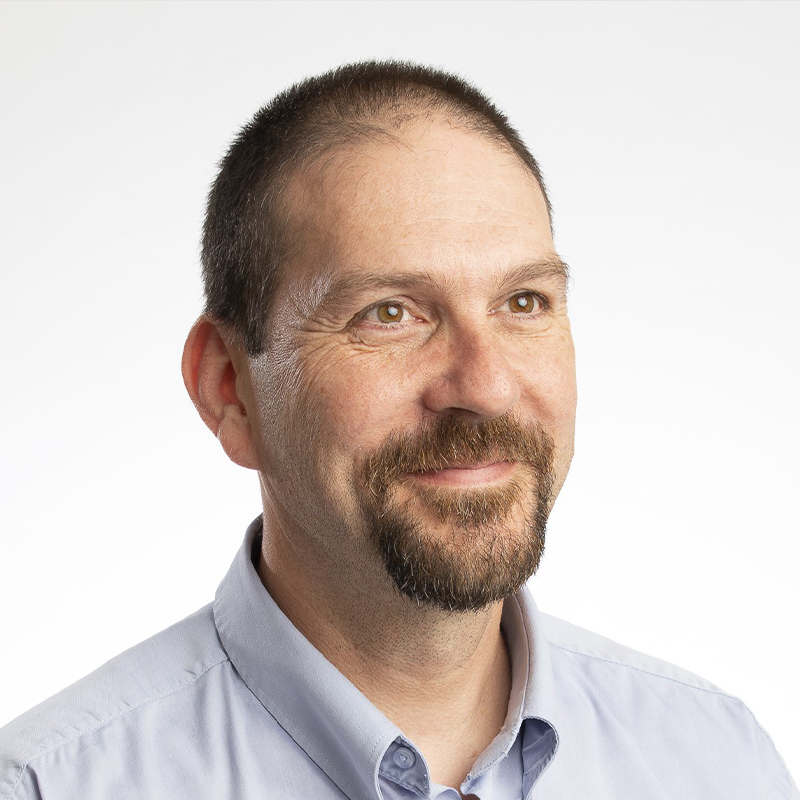
Richard Johnston
Founder. Innovator. Environmentalist.
Dr Richard Johnston is a purpose-driven environmental scientist and is a profilic and widely patented innovator.
Rich holds a doctorate in environmental chemistry and has more than 25 years of business leadership in consulting, technology development and product manufacture. Working in research and development, he has developed a diverse range of commercially successful products from domestic appliances and water filters to electrochemical sensors, potentiostats and spectrophotometers for application in environmental monitoring and analysis.
Due to the urgency of the climate crisis, his work is focused on two related areas:
The mitigation of our environmental impact by developing leading business strategies in sustainability, particularly through impact modelling and analysis and the integration of sustainability processes in new product development.
The research and development of biochar technologies and their implementation into industrial and agricultural processes for carbon capture and soil improvement.
In his commitment to creating more environmentally acceptable practices, Richard’s work demonstrates a straightforward approach to addressing and lessening our impact on the planet.
Outside of work he lives a low impact lifestyle on a 5-acre smallholding and has founded a not-for-profit organisation and a music festival to raise funding for health, social and environmental projects and charities.

Saul Jones
Scientist. Teacher. Catalyst.
Dr Saul Jones is the Lead Researcher in Industrial Energy and Material Sustainability, at the Centre for Industrial Sustainability at the University of Cambridge.
Saul’s background is as a physicist developing energy materials, however, with the scale and immediacy of climate change, he shifted his focus to Industrial Sustainability, and how to deliver rapid large-scale reductions in impact in global industrial systems using only existing technologies. The core of this is challenging the notion that “improvement requires novelty”, and advocates prioritization of reductions in impact which are already possible without material or technological barriers.
He holds dual research roles in the Institute for Manufacturing at the Centre for Industrial Sustainability as the Lead Researcher in Industrial Energy and Material Sustainability, and in the Civil Engineering division as a Research Associate in Sustainability in Construction in the Laing O’Rourke Centre for Centre for Construction Engineering and Technology.
He has existing collaborations on Industrial Decarbonization within the UKRI Catapult Network’s Advance Manufacturing Research Centre, as well as leading delivery of a project through the Industrial Energy Transformation Fund. He is also an advisor to Innovate UK on Material and Manufacturing research strategy, and has worked with the Department of Transport to review Net Zero and Circularity issues within UK transport infrastructure.
He has helped develop and deliver programs reducing fuel, electricity, waste, steam, steel, and cement, directly with global manufacturing and construction companies in the UK, Europe, and Africa which are currently delivering savings over 100,000,000 kgCO2e per annum.
With Terraligo, he hopes to help bridge the gap between top-down and bottom-up approaches to decarbonization with realistic carbon capture strategies alongside rapid & meaningful reduction in emissions.

Meryl Batchelder
Educator. Pragmatist. Enthusiast.
Dr Meryl Batchelder is a Science Teacher in Northumberland and an enthusiastic proponent for climate and sustainability education.
Meryl is a TeachSDG Ambassador raising awareness of the UN Sustainable Development Goals and was one of the first UN Accredited Climate Change teachers, speaking at COP25 on the need to embed climate and sustainability through the curriculum to ensure young people have the knowledge and skills needed for sustainable futures.
Meryl and her students have won numerous awards and competitions through their commitment to STEM projects focused on sustainability. She still juggles teaching in school alongside providing consultancy on climate education and working as a National Coordinator for the Ministry of Eco Education coordinating events, producing teaching resources, hosting workshops, and collaborating with academics.
Meryl has written articles relating to education for sustainable futures for a wide range of organisations including the Guardian, the NEU and The Royal Society. In addition, she has made several media appearances with an aim to raise awareness of the urgency and scale of action we need to address the climate emergency. Working with young people brings the need for change into sharp focus.
Over the years she has completed a doctorate in environmental geochemistry, a post-doctorate in the Natural History Museum and a PGCE in Chemistry. Outside of work she likes to sit down and break bread with people.

Gopal Iyer
Social Scientist. Educator. Analyst.
Dr Gopal Iyer holds a PhD from Newcastle University. He is a social scientist, and his work primarily focused on improving children’s learning outcomes in low- and middle-income countries.
Gopal’s passion for sustainable education grew after leading the flagship program, Kids Action Thru Science (KATS) at Newcastle University. This initiative aimed to enhance children’s and young people’s knowledge and awareness of climate change and the Sustainable Development Goals (SDGs).
As the architect of KATS, he designed engaging activities, including sessions on understanding air pollution through sensors, using storytelling to raise awareness about plastic pollution in oceans, and demonstrating the harmful effects of air and water pollution on human lives. He employed sophisticated methodologies, such as the Leuven Scale, to measure elements like concentration, creativity, engagement, and motivation among children participating in the KATS program.
Gopal has designed and implemented large-scale programs to assess and enhance children’s learning and has led significant assessments for children. He has collaborated with one of India’s pioneering firms dedicated to measuring learning outcomes and has also developed innovative test instruments as well as hands-on materials to improve student learning. He was also associated with the World Bank, where he managed the Programme for International Student Assessment (PISA), aimed at evaluating the life skills of 15-16-year-olds.
At Terraligo, Gopal aims to leverage his expertise in measurement and evaluation to advance sustainable education. He is committed to impacting the lives of children and young people by designing hands-on activities, fostering climate activism, and inspiring them to become catalysts for positive change in a rapidly evolving world. While not at work, he loves to run, cycle, and tackle the curious questions posed by his six-year-old.